
Family life revolves around a constant stream of small decisions: who picks up the children, when to restock the diapers, and when to book the pediatrician’s appointment. Behind every smooth-running day is a rarely visible management effort: anticipating, planning, and checking.
A task can be delegated without delegating the responsibility for anticipating it, planning it, and checking that it gets done. This distinction between doing something and remembering to do it lies at the heart of most imbalances at home.
Family mental load: separating the task from managing it
Vacuuming is a task. Remembering that the house needs vacuuming before guests arrive, checking that there are still vacuum bags, and following up with the person who was supposed to take care of it—that’s the mental load. In many households, one parent carries this invisible burden of anticipation.
The problem isn’t a lack of willingness. It’s that household logistics—medical appointments, school registrations, keeping track of activities, and managing childcare-related disruptions—often remain the responsibility of one person. Sharing tasks without sharing the management load only solves part of the problem.
To rebalance things, several families follow a simple principle: whoever does a task manages it from start to finish, from planning to follow-up. The parent responsible for meals from Monday to Wednesday also plans the menu, does the shopping, and keeps track of supplies. The other takes over for the rest of the week. More ideas for structuring this division of responsibilities can be found in the family section of Mister Free Free, with suggestions for different family setups.

Family organization tools: a chart, an app, or a verbal check-in
A wall planner, a shared collaborative list app, or a quick five-minute check-in on Sunday evening: the format matters less than consistency. The goal is for every adult in the household to have a complete view of the week ahead without having to ask the other person.
How to choose the right tool
- Visibility: everyone in the household should be able to check the schedule without asking. A chart in the kitchen works better than an app nobody opens.
- Updates: a useful tool is one that stays up to date. If the paper schedule is still stuck on the previous week, it’s no longer doing its job.
- Shared ownership: both parents should contribute to the tool, rather than one person filling it in while the other simply checks it. Otherwise, the mental load just shifts to maintaining the schedule.
Verbal check-ins are still underrated. Five minutes to sync up every Sunday (who’s doing what, what unexpected events to plan for, and what deadlines are coming up) can replace dozens of messages during the week. A short weekly check-in is better than a chart nobody reads.
Parents’ screen use and shared family time
Recommendations about children’s screen time are widely shared. Yet adults’ phone use in front of their children is still rarely questioned.
A review published in 2025 in JAMA Pediatrics, covering 21 studies and 14,900 children across ten countries, found an association between parents’ use of technology in the presence of young children and several unfavorable indicators. The authors also reported more favorable outcomes when content was watched together with a parent.
The issue isn’t the screen itself, but what it replaces: a conversation at mealtime, attention during after-school reunions, or being present during free play. A child’s age, the content being watched, parental involvement, and what screen time displaces (sleep, interaction, physical activity) matter just as much as its duration.
Family agreements to protect time together
Banning all technology is neither realistic nor necessary. A few simple agreements can help preserve the quality of time spent together:
- Keep mealtimes and reunions (after school and at bedtime) phone-free for adults too.
- Explain to your child why you’re checking your device, so they don’t see the screen as a silent rival.
- Turn off non-urgent notifications during family time to limit accidental interruptions.
These adjustments don’t require a revolution. They require a shared decision that’s revisited regularly. An explicit agreement between adults reduces tension more effectively than an imposed rule.
Family routines: creating structure without rigidity
A routine isn’t a military timetable. It’s a predictable sequence that helps children (and adults) know what comes next without being reminded. In the morning, getting dressed can come before breakfast or the other way around—it doesn’t matter as long as the order stays consistent.
Routines work best when they’re created together with children from around age four or five. Choosing the order of the evening steps together (bath, story, tidying the bedroom) gives children a sense of control that reduces negotiations.
A common mistake is trying to fill every minute. A good routine provides structure for three or four key moments of the day (waking up, leaving, coming home, and bedtime) and leaves some flexibility in between. That flexibility isn’t wasted time: it’s where free play, spontaneous conversation, and creative boredom can take place.
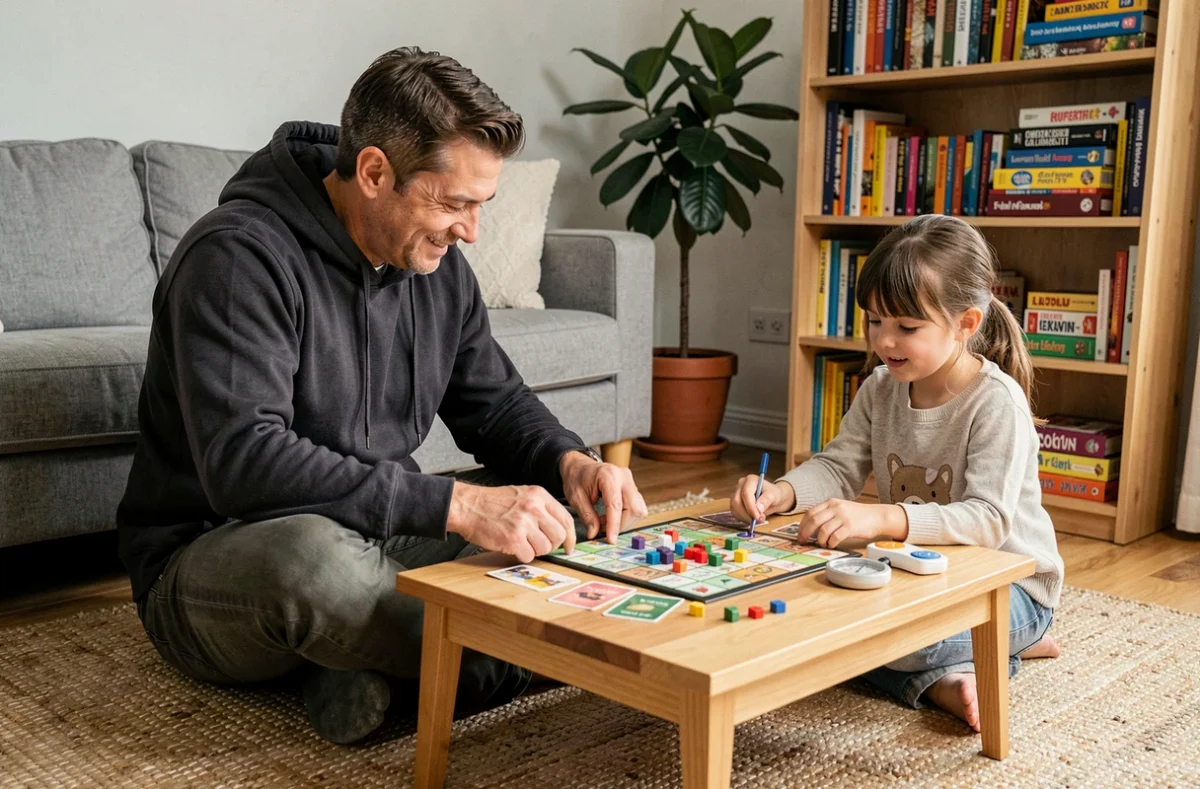
Quality family time can’t always be scheduled. It happens more easily when the logistics run smoothly in the background, without one parent constantly having to remind, follow up, or reorganize. When household logistics run without constant prompting, each parent has more attention to give to the moments that really matter.