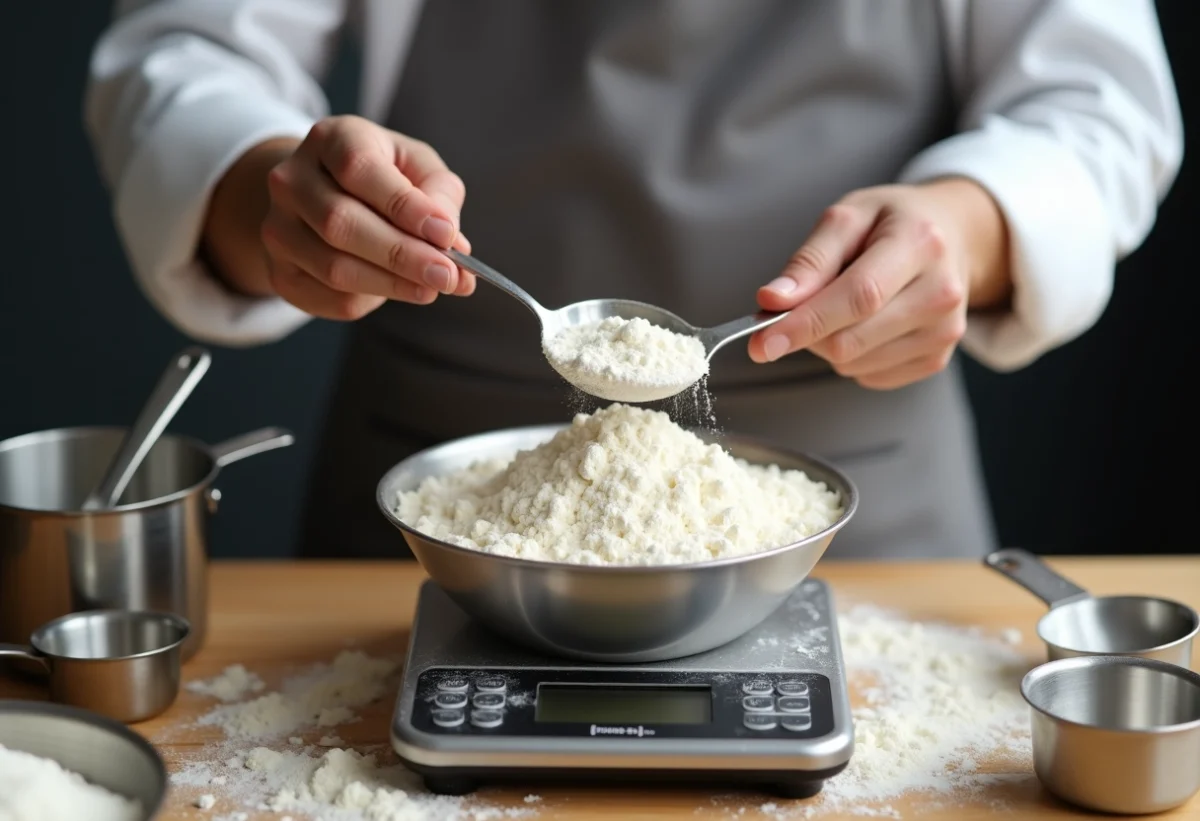
In cooking, precision is often the key to success. Knowing how to convert volumes can turn an ordinary recipe into a culinary masterpiece. For example, switching from cups to milliliters or ounces to grams requires a certain skill and an understanding of equivalences.
For baking enthusiasts, mastering these conversions becomes essential to ensure consistent results. A mistake in measurements can easily ruin a cake or a sauce. Fortunately, a few simple tips and tools like conversion charts can help navigate this terrain with confidence.
Understanding Measurement Units and Their Conversion in Cooking
Cooking, especially baking, demands great precision in measurements. The equivalences between weight and volume are crucial for ensuring the success of a recipe. Commonly used measurement units include cup (CUP), tablespoon, teaspoon, milliliter, and liter.
- One cup (CUP) is equivalent to 250 milliliters.
- One tablespoon corresponds to 15 milliliters.
- One teaspoon is worth 5 milliliters.
- One fluid ounce is approximately equal to 30 milliliters.
Recipes often require conversions between these units. For example, the conversion of 200 ml to liters is simple: divide by 1000, which gives 0.2 liters. Understanding and being able to apply these conversions allows for faithfully following a recipe.
Table of Common Conversions
| Measurement Unit | Equivalence |
|---|---|
| 1 cup (CUP) | 250 milliliters |
| 1 tablespoon | 15 milliliters |
| 1 teaspoon | 5 milliliters |
| 1 liter | 1000 milliliters |
Chefs and cooks must master these conversions to ensure consistency and success in their dishes. Using tools like measuring cups, measuring spoons, and digital kitchen scales greatly facilitates this task. Professional cooking and international cuisine require a rigorous understanding of these equivalences to adapt to various recipes and ingredients.
Techniques and Tips for Accurate and Effective Conversions
To ensure accurate conversions in cooking, use appropriate tools. A measuring cup and a digital kitchen scale are essential. A measuring cup allows you to measure liquids in milliliters and liters, while a digital kitchen scale offers great precision for grams.
When converting, consider the density of the ingredients. For example, 100 grams of flour does not occupy the same volume as 100 grams of sugar. Use conversion charts to adjust your measurements based on the specific densities of the ingredients.
Mobile apps and online converters are also valuable allies. They allow for quick and precise conversions between different measurement units, whether for liquids or solids. Don’t hesitate to incorporate them into your cooking routine.
Recommended Tools for Accurate Conversions:
- Measuring cup: graduated in milliliters and liters.
- Digital kitchen scale: for exact measurement of grams.
- Measuring spoons: for small quantities in milliliters.
- Conversion charts: to adjust measurements according to ingredient density.
Chefs and cooks must master these techniques to ensure the consistency of culinary results. In professional cooking, a conversion error can compromise the quality of a dish. Getting into the habit of using these tools and techniques ensures optimal precision in all your recipes.