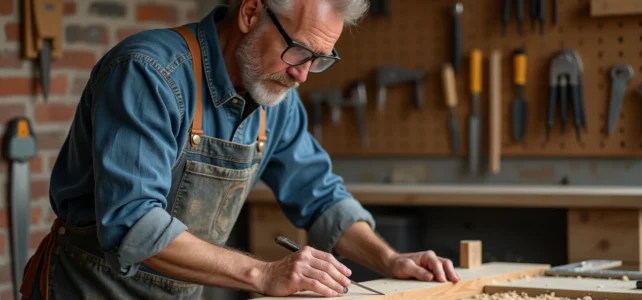
The DIY wood market is undergoing a rapid restructuring phase. Between the tightening regulations on treatment products, the rise of local species long ignored, and the arrival of digital tools accessible to individuals, the usual benchmarks are shifting. We take stock of the developments that truly matter for the informed DIYer.
COV Regulation and Wood Glues: What Changes for the DIYer
The European regulation on biocidal products (EU No. 528/2012) and the REACH updates published by ECHA between 2022 and 2024 have tightened the usage conditions of several common substances in wood treatment. Some biocides used in stains or saturators have had their approval withdrawn or their usage conditions restricted.
On the glue side, epoxy resin hardeners intended for the general public are now under increased scrutiny. ANSES in France and BAuA in Germany now recommend prioritizing low VOC glues for all indoor use. For a home workshop, this means systematically checking the safety data sheet (SDS) before purchase, even for products sold in large DIY stores.
Professionals sharing their monitoring on the Les Copeaux website regularly relay these regulatory developments, allowing for quick filtering of products that are still compliant.
- Check for the “indoor use” label and the emission classification (A+ in France) on the finished product’s label
- Abandon copper-chrome-arsenic (CCA) treatments in favor of thermal treatments or water-based saturators
- Prefer vinyl glues D3 or D4 over epoxy for standard furniture assembly

Local Species for Decking and Outdoor Furniture: Black Locust, Chestnut, Ash
The interprofessional organizations Fibois France and France Bois Forêt have been conducting campaigns since 2023 to reposition French species against tropical woods. Black locust (false acacia), chestnut, and ash are at the top of the recommendations for outdoor projects.
Black locust achieves a natural durability class of 4, making it suitable for direct contact with the ground without chemical treatment. This is a significant advantage in the regulatory context described above. Chestnut, classified 3-4 according to standards, is suitable for cladding and covered decks.
Ash, naturally less durable outdoors, gains a second life thanks to high-temperature thermal treatment (HTT). Wood heated between 190 and 215 °C sees its resistance to fungi significantly increase, at the cost of a slight loss of mechanical strength in bending. We recommend reserving HTT ash for decking boards and wall coverings rather than structural parts.
Butt-jointed poplar, long confined to packaging, is now appearing in the decoration and layout aisles. Its lightness makes it easy to handle in amateur workshops, and its price remains significantly lower than that of oak.
Supply in Trade and GSB
The progress of these species in distribution networks is documented by the interprofessional organizations. Specialized trades are increasingly offering black locust in standard sections, which avoids custom orders. In large DIY stores, chestnut decking is becoming widespread, often positioned as a direct alternative to ipe or cumaru.
Accessible Digital Machining: CNC and Laser Cutting for Individuals
Digital woodworking is no longer reserved for professional workshops. Table CNC machines (A3 to A1 format) are now available at prices that make them accessible to committed DIYers. Their main interest lies in repeatability: producing several identical pieces with precision on the order of a tenth of a millimeter, something impossible with a manual router.
The real barrier remains mastering CAD software, not the cost of the machine. Without skills in vector drawing (SVG, DXF) and tool path generation (G-code), the material investment goes unused. Fablabs and makerspaces often offer introductory courses that allow one to validate the tool’s usefulness before purchase.
Laser Cutting and Engraving on Solid Wood
CO2 laser cutting works well on plywood and fine MDF, but shows its limits on solid wood beyond a few millimeters in thickness. Engraving, on the other hand, opens up possibilities for customization (signage, decorative patterns, marking of parts) that the traditional DIYer could only achieve with a set of chisels and a lot of patience.
3D printing, sometimes mentioned as a revolution for wood, remains marginal. Wood-filled filaments (PLA wood) produce a limited aesthetic finish and do not replace machining or manual work for functional pieces.
Reuse of Wood and Circular Economy in DIY Projects
The reuse of construction materials, encouraged by ADEME, also concerns reclaimed wood. Beams, formwork boards, quality-assured pallets: these sources contribute to an increasing share of furniture and decoration projects.
The technical difficulty lies in the precise identification of the species and the treatment it has undergone. A pallet wood treated with methyl bromide (marked MB) should not be used indoors. Only pallets marked HT (thermal treatment) or KD (kiln drying) are suitable for domestic use.
- Inspect the NIMP 15 marking on the central block of the pallet to identify the treatment
- Sand deeply to remove surface residues and any potential contaminants
- Treat reclaimed wood as raw wood: check moisture with a tester before assembly, accept a higher loss rate than with new wood
The circular economy in wood is not limited to pallets. Offcuts from panels and solid wood from local carpentries represent an underutilized resource. Some carpenters now offer their offcuts for sale, sometimes through platforms dedicated to the reuse of construction materials.
Woodworking is evolving under the combined pressure of regulation, the availability of local species, and the democratization of digital tools. Each of these axes is concretely changing the way to choose a material, treat it, and transform it. Staying informed on these topics is now part of workshop work, just like tool sharpening.