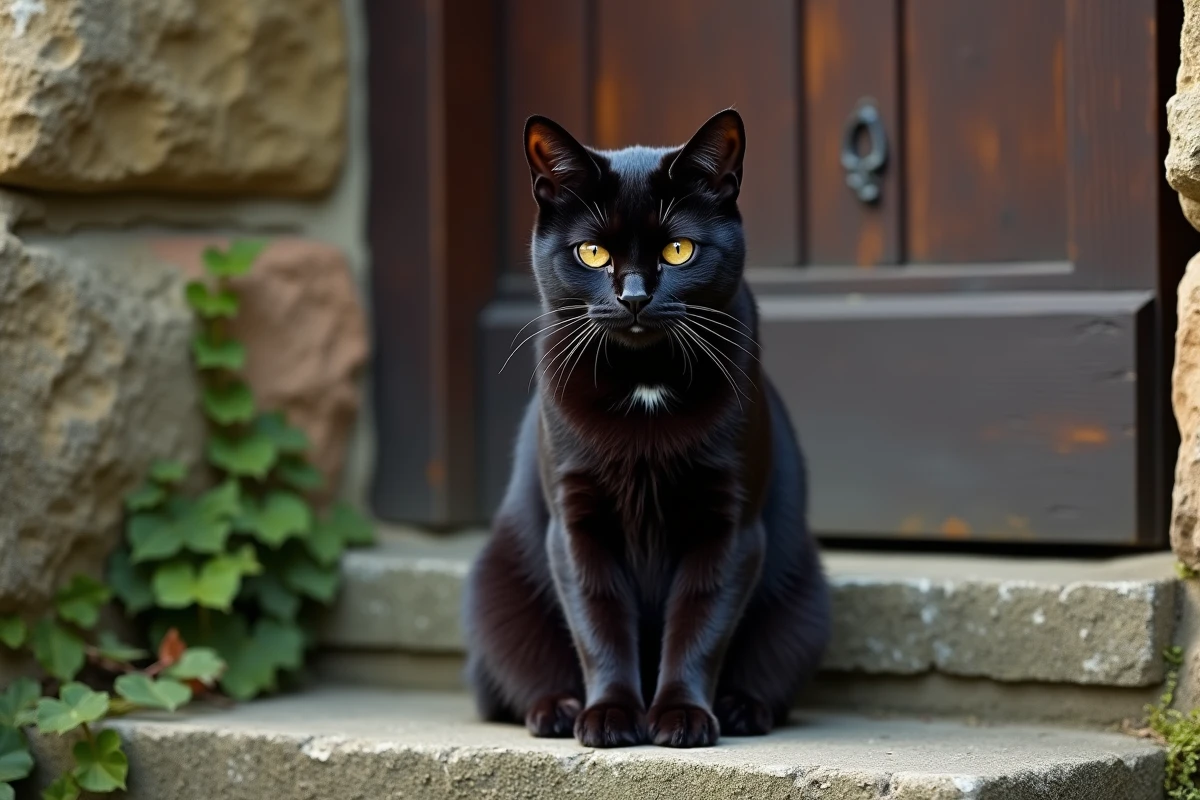
When an unknown cat pushes open the door of a house, interpretations vary depending on whether one adopts a cultural framework or an ethological reading. The spiritual significance of visiting cats depends on cultures, beliefs, and eras. But what do recent ethological observations say in the face of these symbolic readings of the visiting feline?
Feline Ethology and Visiting Cats: What Biological Instincts Reveal
Before attributing a spiritual message to a cat that enters your home, it’s essential to understand why a feline chooses one house over another. Feline ethology provides concrete answers that sometimes overlap with, and at times contradict, mystical interpretations.
A stray or semi-feral cat explores a territory guided by three factors: the availability of food resources, the perceived safety of the location, and the density of conspecifics in the area. A calm home, with little traffic and a stable temperature, naturally attracts felines seeking refuge.
Pheromonal marking also plays an underestimated role. A cat that has previously frequented a space leaves olfactory traces that attract other individuals. This phenomenon explains why certain houses regularly receive visits from different cats, without any spiritual intention being necessary to understand it.
To delve deeper into the spiritual significance of the cat on Boule de Poil, the cross-reading between biology and symbolism enriches the understanding of the phenomenon.
The territorial instincts of the cat explain the majority of feline visits. The search for warmth, food, and calm takes precedence over any mystical dimension, from the perspective of the animal itself.
Symbolism of the Visiting Cat: Comparative Table of Cultural Traditions
Beliefs related to visiting cats differ radically from one region to another. The same feline behavior receives opposing interpretations depending on the cultural context.
| Cultural Tradition | Interpretation of the Visiting Cat | Associated Color |
|---|---|---|
| Ancient Egypt | Divine protection, connection to Bastet | All colors (universal sacred) |
| Medieval Europe | Negative omen, connection to witchcraft | Mainly black |
| Japan (Maneki-neko) | Luck, prosperity, welcoming fortune | Tricolor or white |
| Traditional Islam | Pure animal, welcome in the home | All colors |
| Hinduism | Ambivalent sign, related to the goddess Shashthi | Variable by region |
This table highlights a often overlooked point: the color of the fur alters the symbolic reading in the majority of traditions. A black cat carries a message of protection in Egypt, while it signifies a curse in medieval Europe.
A Recent Case: India’s Regulation of 2023
India banned ritual sacrifices involving cats in traditional Hindu contexts in July 2023. This measure illustrates the tension between spiritual symbolism and animal protection. The sacred dimension of the feline no longer prevents modern legal frameworks from intervening.
Totem Cat and Home Energy: Spiritual Reading vs. Behavioral Data
In contemporary spiritual practices, the cat that visits a house is often interpreted as a totem animal carrying a message related to intuition, protection, or wisdom. Some see it as a sign of positive energy, while others view it as a warning.
Proponents of this reading put forward several recurring arguments:
- The cat perceives energy variations in a space and naturally heads towards areas of calm or tension, making it a detector of spiritual ambiance
- Its ability to sleep in exposed positions would signal a safe place energetically, interpreted as a validation of the home’s harmony
- The purring, which occurs at a frequency associated with relaxation, is seen as a tool for vibrational purification
On the other hand, feline ethology offers more mundane explanations for each of these behaviors. The cat chooses its resting places based on temperature and safety, not according to an energy field. Purring is primarily a self-soothing mechanism, documented in injured or stressed felines, not solely in contexts of well-being.
Feline Intuition or Sensory Hypervigilance
The idea that the cat possesses spiritual intuition often rests on its ability to react to stimuli invisible to humans. A cat staring at an empty point in the room easily evokes a mystical interpretation.
Ethological data point to a sensory explanation. The cat perceives ultrasound, detects minute movements thanks to its whiskers, and has night vision far superior to that of humans. What we interpret as a sixth sense is actually a more efficient sensory apparatus.
Spiritual Significance of Black, Ginger, or White Cats: Variations in Interpretation
The color of the fur remains the most frequent differentiating criterion in the spiritual readings of visiting cats.
- The black cat is associated with protection against negative energies in Egyptian and Japanese traditions, while Western Europe has long linked it to bad luck
- The white cat symbolizes light, purity, and a message of peace in the majority of cultures, with no notable exceptions
- The ginger cat carries connotations of vitality and courage, often associated with solar energy in Celtic traditions
- The tricolor cat concentrates the most positive interpretations, considered a bearer of luck in Japan and Southeast Asia
Conversely, no behavioral data link the color of the fur to a specific temperament or behavior of the cat. The genetics of feline coats do not influence territorial behavior or the propensity to visit certain homes.
The visit of a cat remains an event that each person interprets according to their own framework. Spiritual traditions see it as a sign related to protection, spirit, or the energy of the place. Feline ethology reads it as a territorial behavior guided by sharp senses and concrete needs. Understanding the biological mechanisms of the feline helps to delineate the boundary between observation and belief.