
A belt that slips, rides up, or gaps around the waist poses a common yet annoying problem. Most often, the cause lies in a mismatch between the spacing of the holes and the actual waist size, or the absence of suitable holes. Keeping a hole-less belt in place also depends a lot on the pants worn: a rigid jean, a fluid pant, or a high-waisted model react differently to makeshift solutions.
Pant fabric and belt hold: what really changes
Most tips circulate without specifying on which type of garment they work. This is the blind spot of the subject. A belt knot or a leather flap tucked under a belt loop may work on thick jeans, where the rigidity of the denim keeps everything in place through friction.
On pants made of viscose, linen, or crepe, the situation changes. The fabric slides on itself and on the leather. A mechanical trick (knot, improvised buckle) holds less well because the fabric offers no resistance. In this case, solutions that rely on continuous tightening, such as ratchet buckles or elastic straps, yield better results.
A high-waisted pant adds an additional constraint: the belt experiences constant pressure at the abdomen, especially when seated. Makeshift setups (knotted elastic, paperclip) give way faster on this type of cut than they would on low-rise jeans.
Knowing how to keep a belt without holes therefore first requires identifying the pants in question, then choosing the method suited to its fabric and cut.
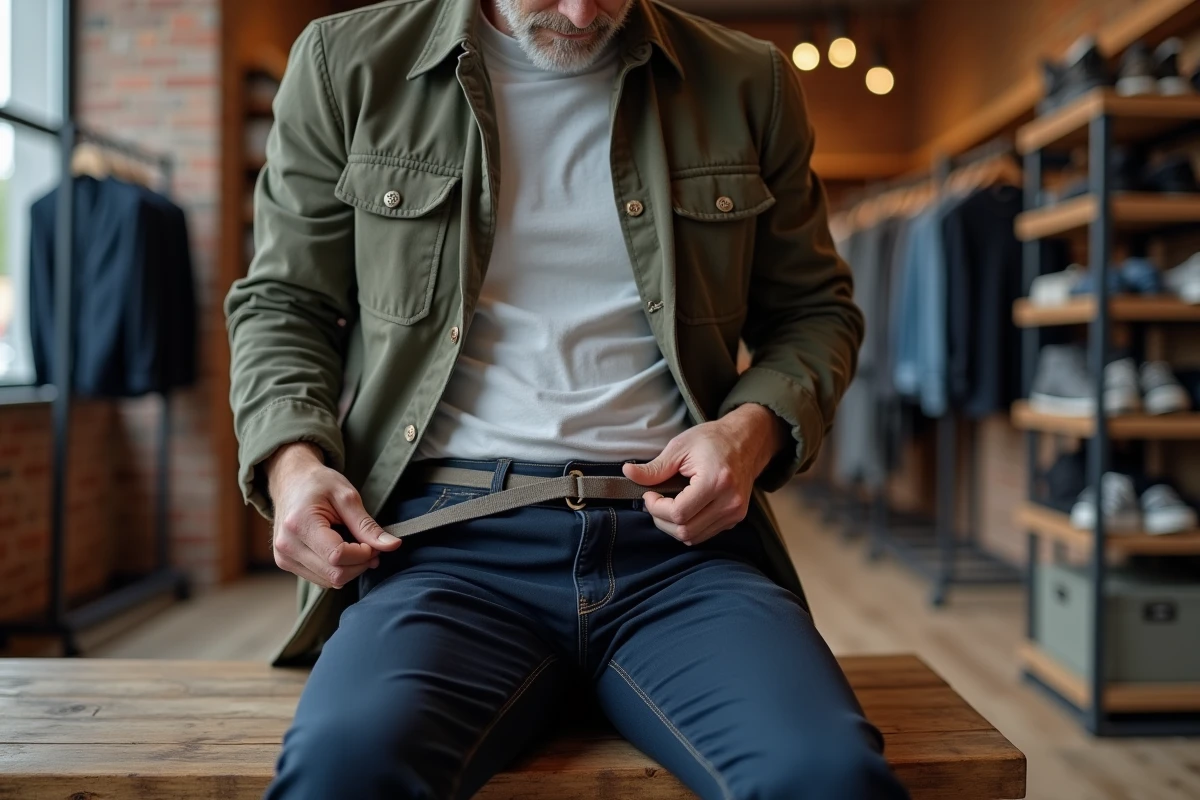
Ratchet buckle or continuous tightening: an alternative to classic holes
Continuous tightening belts use a toothed rail integrated into the back of the strap. The buckle engages at any notch, allowing for a millimeter adjustment without perforating the leather. The mechanism relies on a small lever that must be lifted to release the strap.
This system has a clear advantage on fluid pants: the tension remains constant, without a localized weak point like a hole that becomes oval over time. However, on raw denim where the belt experiences repeated friction, the ratchet may get dirty faster. A periodic cleaning of the rail is usually enough to restore the locking mechanism.
The other common option, the woven elastic belt, works without holes or notches. The prong fits between the braids at any point. The flexibility of the elastic absorbs variations in waist size throughout the day, making it a logical choice for prolonged sedentary activities (office, driving).
Limitations to know about these systems
A poorly sized ratchet belt in width will not fit through narrow loops. Checking the width of the pants’ loops before purchase avoids a frustrating incompatibility.
Woven elastic belts, on the other hand, lose their tension after several months of heavy use. The braiding relaxes and the hold diminishes. Field reports vary on this point: some users notice rapid loosening, while others do not, depending on the quality of the braiding and the frequency of wear.
Temporary solutions: those that hold and those that damage the garment
The DIY tips circulating online are not all equal, especially from the perspective of the garment itself. Here are the main ones, ranked by impact on the pants:
- The flat knot of excess strap around the loop: works well on thick jeans or chinos, but deforms the thin loops of dress pants by exerting constant lateral tension.
- The hair elastic wrapped around the prong to hold the strap at the right length: a discreet and risk-free solution for the fabric, effective on all types of pants. Its limit: the elastic breaks after a few days.
- Adding a hole with a heated nail or punch: a permanent solution, but it weakens the leather if the hole is poorly placed. A rotary punch gives a cleaner result than a nail, with a neat edge that does not tear under tension.
- The paperclip or safety pin slipped into the strap to shorten it: holds for a few hours, but the metal can mark the leather and scratch the buckle. On light-colored pants, the friction of the paperclip may also leave a dark mark on the fabric.
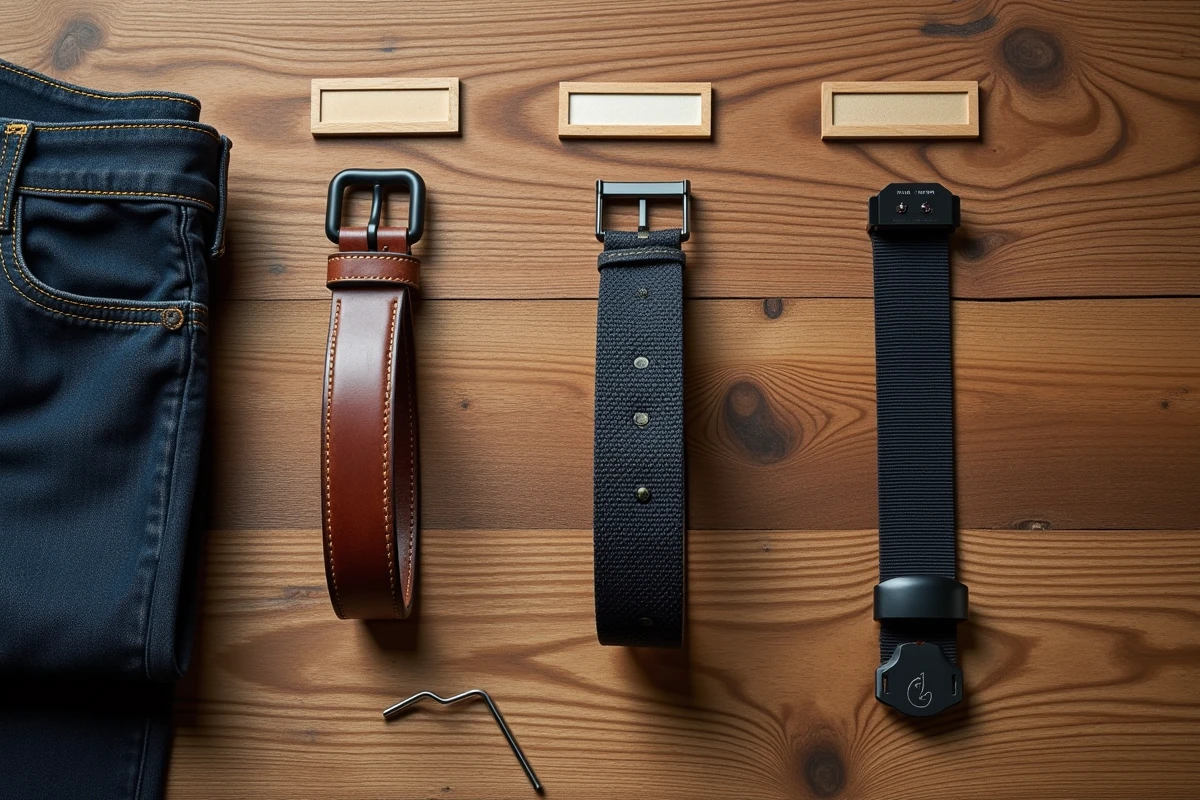
Which tip for which use
For a one-time fix (a day, an event), the hair elastic remains the safest compromise. It leaves no marks on the belt or the pants.
For daily use, it’s better to invest in a continuous tightening belt rather than multiplying makeshift solutions. Repeated temporary solutions eventually damage the loops, oval the existing holes, or prematurely wear the leather at the folding point.
Hole-less belt on pants without loops: a special case
Some pants, particularly fluid models, fitted suit pants, or skirts with elastic waistbands, do not have loops. The belt is then held only by the friction between the strap, the fabric, and the pressure of the tightening.
On slippery fabric (satin, smooth polyester), no classic belt will hold without loops. A wide textured leather belt adheres better than a thin, smooth strap due to the increased contact surface. Flat buckle elastic belts also work in this configuration, as the elastic tension keeps the strap pressed against the fabric at all times.
A frequently recommended trick is to sew temporary loops from cotton ribbon inside the pants. Three stitches are enough, and the ribbon can be removed without leaving a trace on most fabrics. This hybrid solution (removable loop and hole-less belt) offers the most reliable hold for garments lacking original loops.
Thus, the choice of method always depends on the belt-pants duo. A solution that works on straight jeans may not necessarily suit fluid pants worn without loops. Testing on the garment in question, both sitting and standing, remains the only way to assess the actual hold before heading out.